For Recruiters, Recruitment Managers, Recruitment Directors,Heads of Talent & Chief People Officers

One forensic layer between a resume
and reality.

Platform Intelligence is not another ATS, background check, or workflow your team has to learn. It is one verified layer that sits between a resume landing in your pipeline and that resume reaching a client. Built for enterprise staffing operations that cannot afford a compromised submission.

Paste · Scan · Know · under thirty seconds

DPIIT Recognized Patent-pending engine No signup to validate
🔒 wackowave.cloud / intelligence
WackoWave Platform Intelligence — Profile Alignment Score and Layer Breakdown
Analyzed in
under 30 seconds
VP of Talent Acquisition
Chief People Officer
Head of Recruiting Ops
Staffing Firm Leadership
The current reality

A Tuesday in one of your recruiter's actual week.

Not theoretical. This is the pattern across every staffing operation pushing contract, C2H, and FTE submissions into enterprise clients. Read it and ask how many lines match what is happening on your team right now.

09:00
Five new resumes land in the recruiter's inbox for an active enterprise role. They start reading. 15 minutes per resume, just to form a baseline feel.
~75 min
10:15
Screen call with candidate #1. Resume says eight years Java. Conversation sounds more like four. Recruiter is now unsure — submit or dig further?
~30 min
11:00
Three candidates submitted to the hiring manager anyway. Client expects volume. The recruiter is hedging, and everyone on the team knows it.
hope-based
14:30
Hiring manager calls: "The second profile you sent — his AWS cert doesn't verify. And the first one's LinkedIn dates don't match the resume."
trust eroded
15:00
Your recruiter scrambles to explain, apologise, promise to pre-screen harder. Both candidates pulled. The hiring manager takes a mental note about your firm.
45 min + brand
16:00
Your team is now behind on tomorrow's pipeline. Resumes get read faster. The next cycle begins — less time, same pressure, same incomplete information.
compounds
×N
Every recruiter on your team has a Tuesday like this. Multiply by 8, 15, 40 recruiters. That is the number sitting on the other side of your P&L.
The math

What that week is actually costing your firm.

Figures drawn from industry research and directly-operated staffing firms. Pressure-test each number against your own operation — most leadership teams find these conservative.

15–20 hrs
Per recruiter per week on unverified screening
Resume reading, screen calls, second-guessing, pre-submission rechecks. Pattern-matching work that could be delegated to a verified layer.
SIA Staffing Analysts · Internal surveys
1 in 3
Profiles carry verifiable risk
Credential mismatches, timeline overlaps, title inflation, experience padding. Not always fraud — often disclosure gaps. Either way, critical to know before submission.
SHRM · HireRight screening benchmarks
3–6×
Salary cost of one bad placement
Replacement cost, lost productivity, damage to the client relationship that approved the PO. For a $120K role, roughly $360K–720K in true downstream cost.
US Department of Labor · SHRM studies
2–3
Clients lost per year to pipeline noise
Not because of a fraudulent submission — because two inconsistent profiles went out in a row. Trust is a streak. Once broken, the client screens you harder.
Staffing industry retention research
Why your conversion is slow

It is not the market. It is the noise.

A soft placement month is rarely market-driven. More often, the market is fine and something upstream is throttling the entire funnel.

The pattern most leadership teams miss
Your recruiters submit more candidates because they do not fully trust the pipeline. Your clients take longer to decide because they do not fully trust your submissions. Close rates drop — and the team blames the market.
It is rarely the market. It is the noise pushed through the funnel. Every profile submitted with quiet doubt extends the client's review time, lowers their hit-rate on your submissions, and slowly trains them to screen you harder. Slower conversion is a downstream symptom of an upstream trust problem. Remove the noise at source and every metric downstream compresses.
// Trust debt compounds across submissions
High Low Sub 1 Sub 8 Client trust
Each submission with an unverified flag lowers the next one's hit-rate. By submission 4, clients are screening harder. By 8, they are comparing you against other suppliers.
See the engine

This is what forensic verification actually looks like.

Not a black-box score. A structured, evidence-backed assessment with confidence percentages, labeled findings, and a suggested next step — the kind of report a Head of Talent can share directly with a hiring manager.

01 · Executive Summary

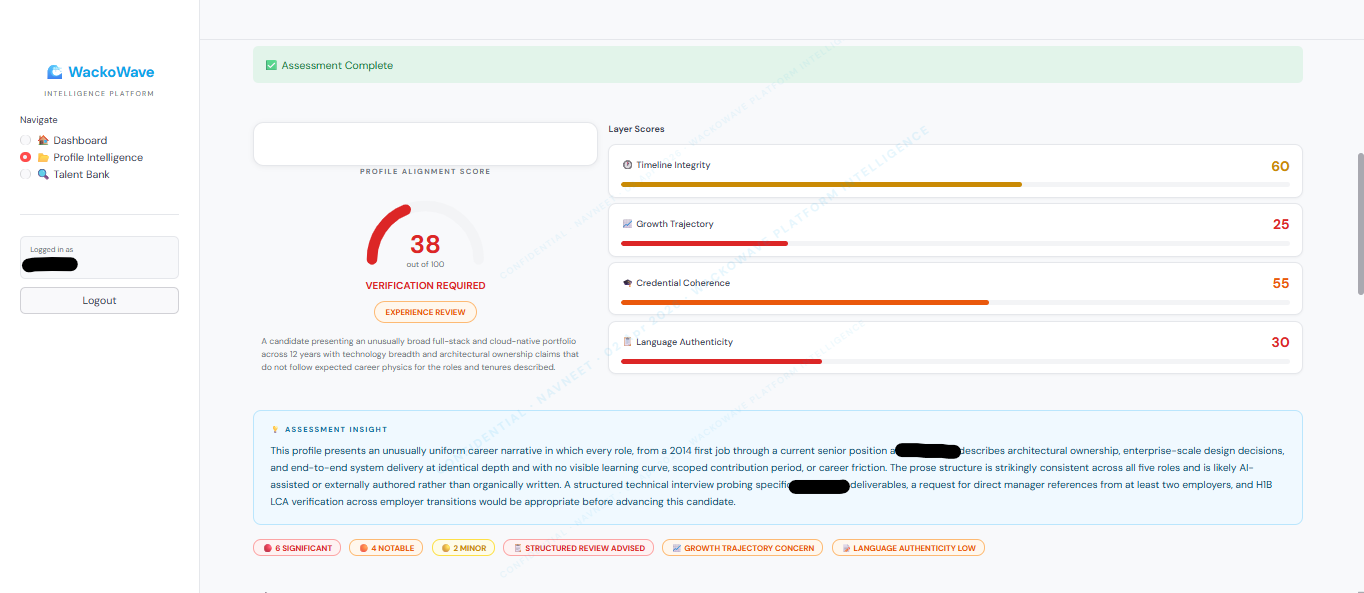
A single alignment score. Four forensic layers behind it.

Every profile receives an alignment score from 0–100, broken down across four independent analytical layers: Timeline Integrity, Growth Trajectory, Credential Coherence, and Language Authenticity. Each scored separately. Each auditable.

Timeline Integrity Growth Trajectory Credential Coherence Language Authenticity
🔒 wackowave.cloud / profile-intelligence
Profile Alignment Score with Layer Breakdown
02 · Detailed Findings

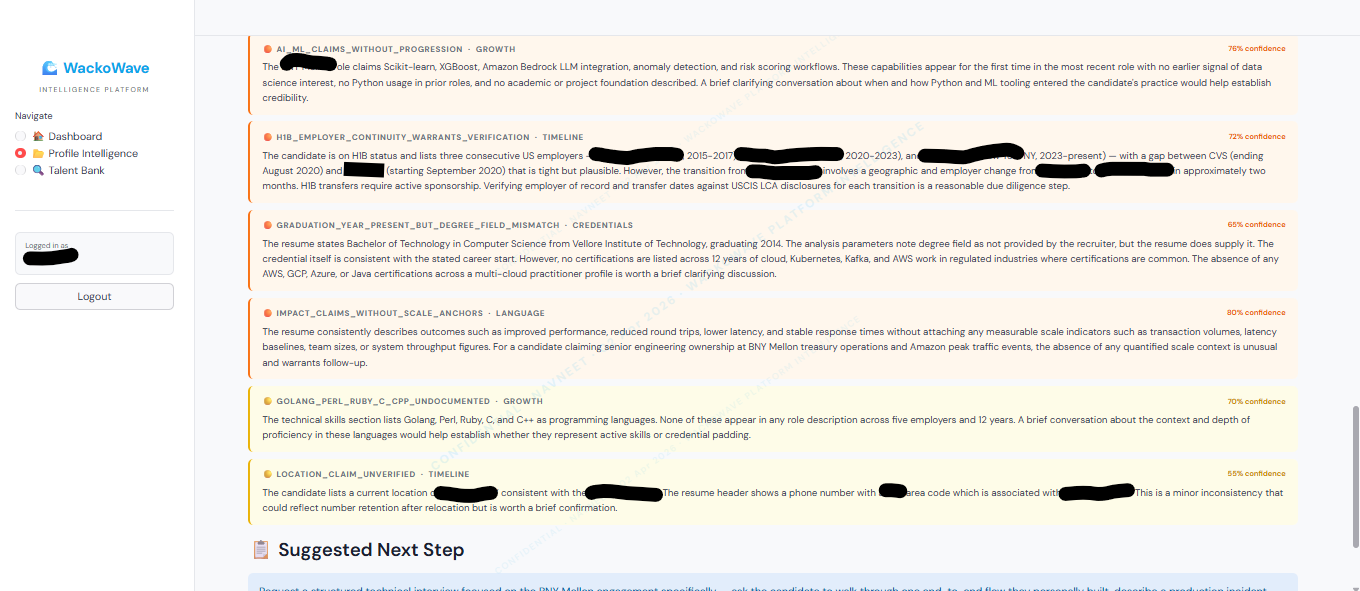
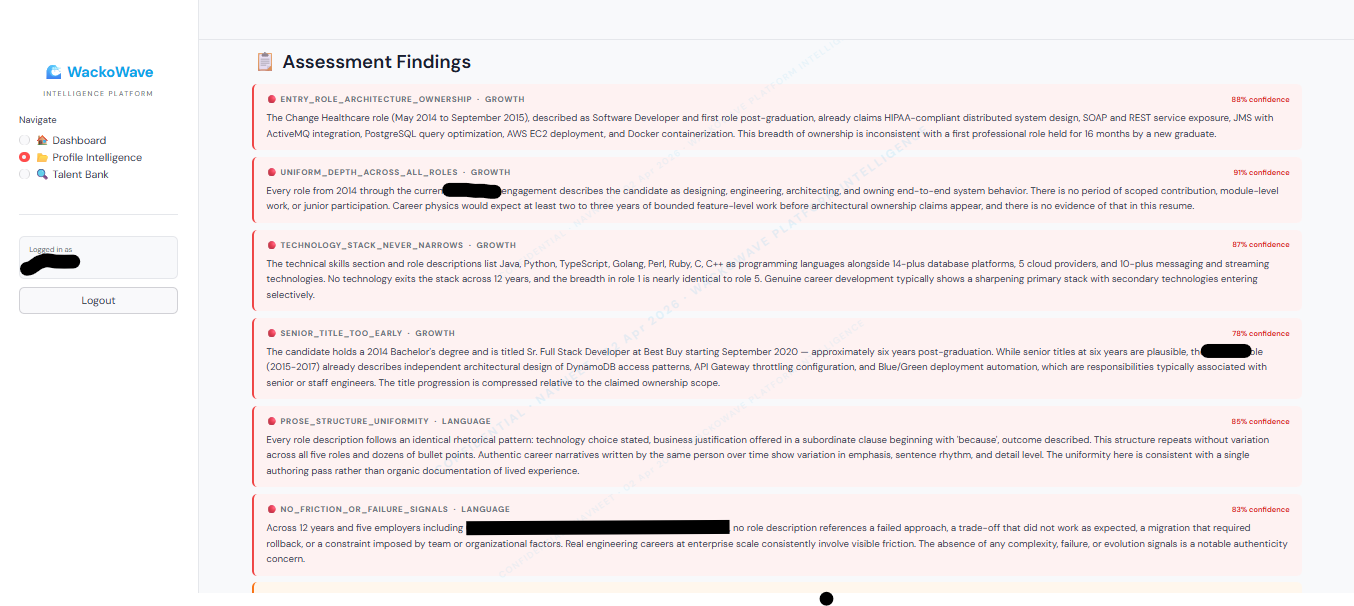
Every flag labeled and explained.

Findings are categorized by severity (significant, notable, minor) and domain (growth, timeline, credentials, language). Each one carries a confidence score and a specific explanation grounded in evidence from the resume — not vague red flags.

6 Significant 4 Notable 2 Minor
🔒 wackowave.cloud / findings
Assessment Findings — labeled forensic flags with confidence scores
03 · Suggested Next Step

Not just flags. An analyst recommendation.

Every assessment closes with a specific, actionable next step — what to ask in the interview, which references to request, which employer records to cross-check. The kind of brief an experienced recruiting analyst would hand a hiring manager before they advance a candidate.

Structured interview brief Cross-check recommendations Reference priorities
🔒 wackowave.cloud / next-step
Suggested Next Step — analyst recommendation with structured interview brief
Walkthrough

Watch the engine run in real time.

Ninety seconds. From resume upload to full forensic report. No narration overlay — just the product working.

Platform Intelligence — product walkthrough
Product Walkthrough
The engine, running on a real resume
▶ Play
What you will see: Resume upload → parameter entry → five forensic layers processing → full report with findings, suggested next step, and branded PDF export.
The change

Same recruiter, same week, different math.

Not a promise. A demonstrable shift in how the same Tuesday plays out when one verified forensic layer sits between the resume and the submission.

Before This Tuesday
  • 15 minutes per resume to read, assess, and form a gut feel.
  • Screen calls on partial information. Half the questions exist only because nothing on the page has been verified.
  • Submissions made under pressure. Volume pulled forward to hit client quotas.
  • Credential issues surface at the hiring manager, not before. Damage control becomes the afternoon.
  • Placement rate sits lower than it should. The team blames the market.
Net: 15–20 hours lost per recruiter per week to pipeline friction and after-the-fact damage control.
After Next Tuesday
  • 30 seconds per resume to know whether it warrants deeper review.
  • Screen calls on verified baselines. Every question is about fit, not credibility.
  • Submissions made with confidence. Every profile pre-flagged against five forensic layers.
  • Credential issues surface before submission, every time. The afternoon belongs to finding new candidates.
  • Placement rate climbs because submissions carry signal. Hiring managers open your emails first.
Net: 15–18 hours reclaimed per recruiter per week. Same effort — directed at people who can actually place.
Zero integration overhead

There is no workflow to change. That is the point.

Most enterprise tools fail at the adoption layer — IT tickets, training cycles, vendor procurement, workflow redesign. We deliberately built none of that in.

Nothing to install. No software on your team's machines, no browser extension, no mobile app.
Nothing to integrate. No ATS plug-in, no VMS connector, no IT ticket, no single-sign-on setup.
Nothing to train your team on. If a recruiter can paste a resume, they already know how to use the product.
Nothing to procure. No credit card to start, no SOW, no vendor onboarding, no security review to delay launch.
+
One browser tab. One paste. One forensic report. That is the entire workflow — for every recruiter on the team.
What happens when you sign up

The first week, step by step.

Concrete, not aspirational. This is what a recruiter's first seven days with WackoWave Platform Intelligence look like — visually and operationally.

Minute 0
Validate your first profile
No signup required to run the first scan from the homepage. Thirty seconds later, five forensic layers have processed and a report is waiting behind an email gate.
Minute 1
Unlock the full assessment
Enter a work email. The alignment score, risk level, and layer-by-layer breakdown reveal. A branded PDF lands in the inbox in parallel.
Day 1
Your team logs into the platform
Clean dashboard. No feature discovery. Profile Intelligence engine available from the sidebar. No training needed — the flow is identical to the public scanner.
Day 2
First catch before submission
A resume your team would have submitted yesterday does not go out today. A verified candidate goes in its place. The hiring manager does not know what did not happen. Your team does.
Day 3–5
It becomes routine
Validate, read, decide. The scan happens inside the existing flow, not alongside it. No browser extensions, no ATS integrations, no IT conversations.
End of Week 1
Hours reclaimed across the team
Fewer screen calls on the wrong candidates. Submission-to-interview ratio begins moving. Leadership sees the first measurable shift in pipeline velocity.
Week 2+
Your client notices
Not because you tell them. Their hit-rate on your submissions goes up. The hiring manager opens your emails first. The compound effect — and it does not reverse.
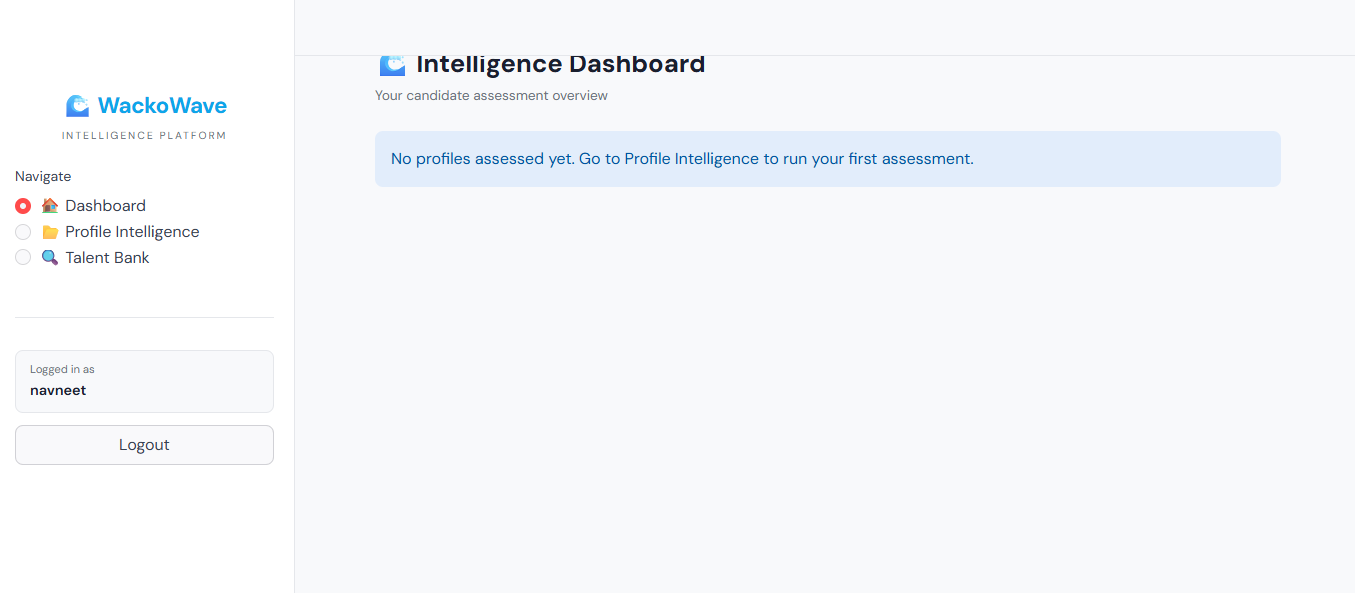
🔒 wackowave.cloud / dashboard
Platform Intelligence Dashboard — empty state
Day 1 — your team's first login
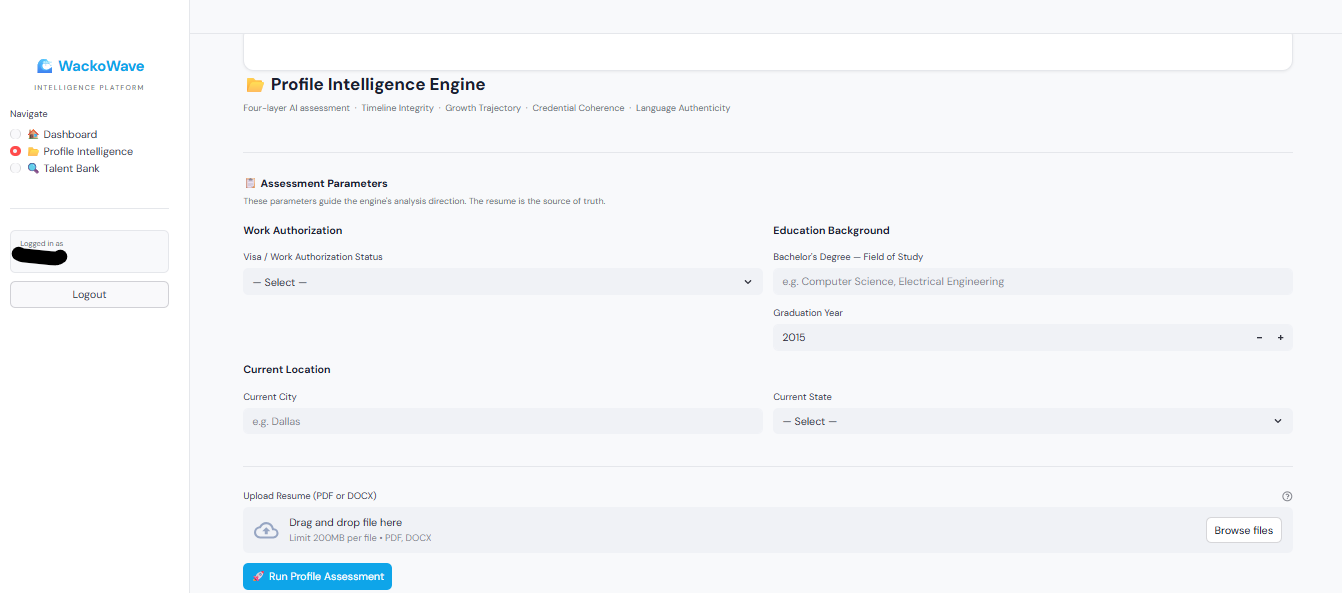
🔒 wackowave.cloud / profile-intelligence
Profile Intelligence Engine — assessment parameters and upload
Day 1 — first validation run
Active pilot

Already running inside a US staffing operation.

Platform Intelligence is live with a leadership team who validated the math before signing. This is what they are seeing in week one.

CH
"We ran six active pipeline candidates through it on day one. Two came back with flags we had not caught. One would have been submitted to a Fortune 100 client this week. That single catch paid for the year."
Director of Recruiting · Chicago IT staffing firm Pilot active
Who's behind this

Built inside the problem, not from outside it.

Platform Intelligence was not built by someone watching the staffing industry from a distance. It was built by someone who spent 25 years inside it — placing US technology talent, running cross-border delivery, and feeling every one of the problems described on this page.

Navneet Chalana — Founder, WackoWave Platform Intelligence
Founder · 25 years
Platform Intelligence exists because I spent a quarter-century watching good recruiters lose good client relationships over resumes that could have been caught in thirty seconds. I built the layer I would have wanted on every one of those Tuesdays.
Navneet Chalana · Founder, WackoWave Platform Intelligence
Platform Intelligence — founder's introduction
Founder's Introduction
Why Platform Intelligence exists
▶ Play
Navneet explains the problem he built this to solve — in his own words.

You have read this far.
You already know.

Your current pipeline has compromised submissions in it right now. Validate one. See what we find. No signup required to start, no credit card, no obligation.